

Your AI visibility score is improving.
Great…
But does that mean AI is recommending your brand when buyers compare options? Is it describing your brand accurately? And what should you do next?
A single score can’t answer those questions.
Most AI visibility platforms provide a headline score, including our own Xofu brand strength indicator. It’s useful for understanding where you stand, but it doesn’t tell you what’s working, where visibility is breaking down, or which tactics will make a difference.
That’s why we use the Six Layers of AI Visibility.
The framework helps identify where and how a brand appears in AI answers, diagnose what’s holding it back, and determine what to address before investing in a solution.
Why a Visibility Score Can’t Tell You What to Fix
Traditional SEO has taught us to diagnose performance across rankings, traffic, links, and conversions.
AI visibility requires that same discipline, but introduces additional uncertainty between discoverability and business outcomes.
We need to understand what information AI systems retrieve, how they use it, whether they mention or recommend the brand, and how they frame it.
Those distinctions help you decide what to fix.
More citations, new content, or technical improvements might help, but an aggregate visibility score alone can’t tell us which intervention is needed.
With one client, we initially looked at visibility only, but found sentiment was the bigger problem. And more citations could have surfaced more of the negative sentiment the brand was already struggling with.
In traditional search, someone would have had to compare reviews and competitor ratings themselves. AI can pull that information together and put it front and center. The issue wasn’t just whether the brand was mentioned, but how it was framed.
Another example involved a Fortune 100 company, one of the top three in its niche. Its current promotion made it the lowest-priced option for a relevant buyer query, but ChatGPT did not recommend it.
During our investigation, we found an outdated Bing search snippet containing incorrect pricing information. That appeared to offer a possible explanation, although we couldn’t establish precisely whether or how it influenced ChatGPT’s answer.
The first revealed a sentiment problem. The second involved outdated information that may have affected a recommendation.
Neither would have shown up in a rollup visibility score.
The Six Layers of AI Visibility
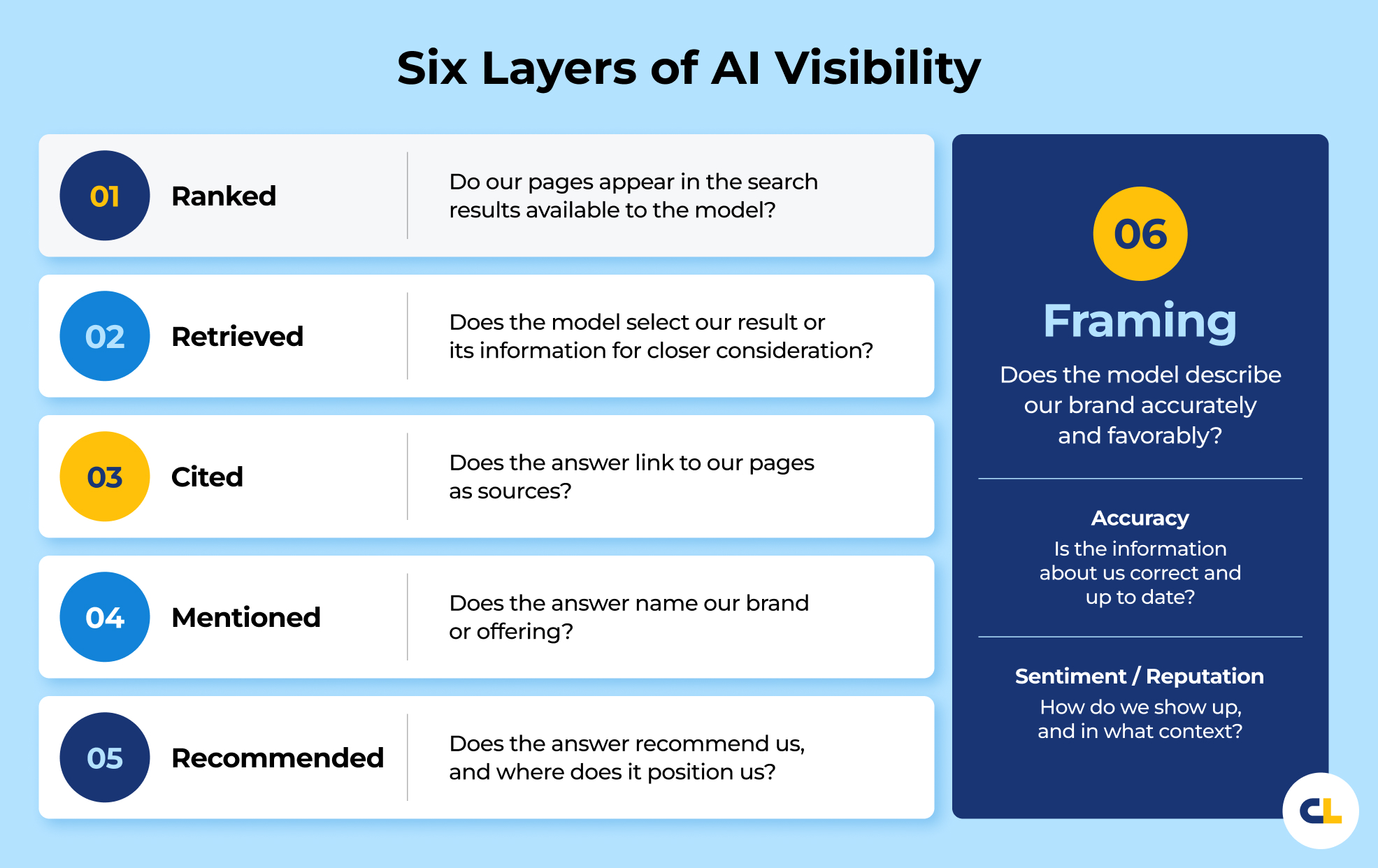
The Six Layers of AI Visibility describe where and how a brand or its information appears as an AI system gathers sources and generates an answer.
They are Ranked, Retrieved, Cited, Mentioned, Recommended, and Framing.
These layers aren’t a fixed sequence of steps an AI system follows. They’re distinct dimensions of visibility we can observe and measure, although some are harder to observe than others.
Together, they help us examine discoverability, retrieval, citations, mentions, and recommendations. Framing applies across these dimensions, helping us evaluate how accurately and favorably a brand is represented.
Looking at each dimension separately helps identify visibility gaps without assuming a fixed sequence or causal relationship.
1. Ranked
Ranked is the traditional SEO layer.
When an AI system runs searches to ground its answer, do your pages appear in the search results available to it?
For a lesser-known brand, or a question about a particular offering, ranking puts you in the result set the model can use to inform its answer. You get the opportunity to be considered. But that doesn’t mean the model will use your information.
AI systems also have their own indexes, cached information, and training data. We can measure traditional search results more directly, but they don’t represent everything the model knows or uses.
2. Retrieved
Retrieved takes us one step beyond appearing in search results.
Of the information returned, what does the model select for closer consideration?
A source appearing in retrieved results doesn’t necessarily mean the model read the page or used its contents. It may have considered only the title, snippet, or metadata without accessing the page itself. Even when we can confirm a page was accessed, that alone doesn’t establish whether or how its contents influenced the answer.
We also see models retrieving results beyond the traditional top 10. Their query fan-outs can be very specific, sometimes using site-specific search operators to narrow what they’re looking for.
Ranked and retrieved are among the harder layers to observe. Different AI platforms expose different amounts of information, so we’re often working from a limited view of what the model considered and read.
3. Cited
Cited is when an AI answer links to one of your pages as a source.
Does the model cite your content when generating its answer?
That citation might be an inline link, an expandable source list, or a link displayed alongside the answer.
Citations tell us which sources an AI system references, but not necessarily which information it used to construct the answer.
A source can inform an answer without being cited, and a citation doesn’t establish whether or how much that source influenced the response.
That’s why we need to measure citation visibility and brand visibility separately.
4. Mentioned
Mentioned is when your brand, company, or product appears explicitly in the generated answer.
Does the model mention your brand or offering in its answer?
That doesn’t always require the parent brand’s name. The model might mention a specific product without naming the company behind it. If the product is clearly associated with that company, it still counts as a mention.
This is where visibility becomes unquestionable. The brand has made it into the actual answer. But being mentioned is still different from being recommended.
5. Recommended
Recommended is when an AI system includes your brand or offering among the solutions it suggests to the user.
Does the model recommend your brand, and where does it position you among the options?
Typically, we’re talking about a much shorter list than traditional search results, perhaps two to five options.
When an AI answer ranks its recommendations, the top position typically represents the strongest recommendation. But AI systems don’t always present options in a ranked list.
What matters is whether your brand is presented as the strongest fit for the buyer’s needs. Sometimes that’s reflected in list position. Other times, it’s conveyed through the language and emphasis of the recommendation, including how alternatives are qualified.
Think of a product review that tests 20 humidifiers and identifies three best picks. Being among the 20 tested is like getting mentioned. Being one of the three picks is getting recommended.
But not all recommendations carry equal weight. You might be included as an “also consider” option rather than the best fit for the buyer’s question. And a recommendation might happen immediately or several exchanges into a conversation.
6. Framing
Framing is how an AI system describes and evaluates your brand.
Is the model describing your brand favorably and accurately?
Unlike the other five layers, framing isn’t a separate final step. It helps us evaluate the quality and accuracy of a brand’s visibility across the framework.
We look at framing in two ways:
- The first is sentiment or reputation. Is the brand being described favorably or unfavorably, particularly compared with competitors?
- The second is accuracy. Are the attributes, capabilities, pricing, and other descriptors the model assigns to the brand correct?
Models can develop an understanding of a brand through information they’ve encountered repeatedly. When that information becomes outdated, newer information doesn’t necessarily replace it immediately.
There’s an element of inertia.
A model may currently associate a brand with particular descriptors, and it can take recurring new information across different sources to change that understanding.
Framing gives us another way to evaluate visibility across the six layers.
We can examine how accurately and favorably AI answers describe a brand when it’s mentioned or recommended, and identify where inaccurate or unfavorable information appears.
We can also examine the cited sources for potential explanations, but we can’t assume those sources caused the model to frame the brand in a particular way.
Diagnosing Gaps Between the Visibility Layers
Once you separate the layers, you can start identifying specific gaps:
- Ranked but not retrieved: Your source is available in the search results, but the model isn’t visibly retrieving it for closer consideration.
- Retrieved but not cited: Your content appears among retrieved sources but isn’t cited in the answer.
- Cited but not mentioned: Your source is cited in the answer, but your brand isn’t mentioned.
- Mentioned but not recommended: Your brand appears, but the model isn’t presenting it as a suitable option.
- Strong visibility with weak framing: Your brand is appearing, but the information or sentiment surrounding it is inaccurate or unfavorable.
The layers aren’t strict dependencies.
These gaps describe what we can observe, not necessarily how the AI system used the information. Retrieval doesn’t prove a source was read or used, and citation doesn’t prove a source influenced the answer.
A model may know enough about a brand to mention or recommend it without first visibly retrieving a search result.
A brand that’s absent from search results has a different problem from one that’s frequently mentioned but rarely recommended. Both are different from a brand whose reputation or inaccurate descriptors are holding it back.
And we need to evaluate those gaps against specific buyer questions, offerings, competitors, and AI platforms.
Where AI Visibility Changes the Competitive Picture
A brand can dominate traditional search results and still lose ground in AI recommendations. Competitors may be presented as stronger fits, or outdated information may create objections that rankings and traffic reports don’t reveal.
A rollup visibility score can hide the same problem. It may show that your brand appears frequently without revealing whether you’re the strongest recommendation, an “also consider” option, or being described unfavorably.
To identify those gaps, compare AI answers across specific buyer questions:
- When are competitors recommended ahead of you?
- Where is your brand mentioned but not recommended?
- Which descriptions of your brand are inaccurate or unfavorable?
These differences give you a more useful starting point for determining where to intervene.
From Visibility Gaps to Business Impact You Can Measure
Once you’ve identified your visibility gaps, the next step is deciding what to change.
At Citation Labs, we use our Visibility Probe to identify gaps across the six layers. We then build an Opportunity Map that connects those gaps to the tactics and services that could address them.
Different gaps call for different investigations before choosing a solution:
- Weak rankings or retrieval: Examine which sources appear for relevant buyer questions, how your content compares, and where discoverability breaks down.
- Retrieved but not cited or mentioned: Examine the sources AI systems favor and what information they provide. This may reveal gaps in your own content or third-party coverage.
- Inaccurate descriptors or negative sentiment: Identify where unfavorable or outdated information appears and whether your own and third-party sources provide accurate, consistent information.
Depending on what we find, the intervention might involve improving existing content, publishing new third-party resources, or earning link insertions within relevant pages AI systems already cite.
For example, if you’ve commissioned a survey that’s only published on your website, the model may discount it as biased. Getting that information onto other relevant sites can help reinforce the findings through consistent information and stronger trust signals.
From there, prioritize opportunities based on likely effectiveness, cost, difficulty, and available resources.
Some work you can handle internally. Other gaps may require outside support.
Traditional SEO and citations still matter, even if they aren’t generating much referral traffic. Without visibility in the earlier layers, getting recommended becomes much harder.
Tracking Changes Across the Visibility Layers
A visibility snapshot establishes a baseline. From there, we identify a gap, develop a hypothesis about what’s causing it, and test an intervention.
Then we measure whether the expected change occurred, ideally against a control or comparable baseline. This helps distinguish meaningful improvement from the normal variability of AI-generated answers.
Depending on the gap, we might track citation rates, sentiment, mentions, recommendations, or brand strength relative to competitors. If the results don’t support our hypothesis, we need to revisit the diagnosis or adjust our approach.
Ultimately, the goal is revenue.
But there’s a whole journey before someone becomes a lead or customer. If you’re failing earlier in that journey, you have fewer opportunities to influence later decisions.
And because AI platforms, retrieval behavior, and information sources keep changing, you’ll need to continue measuring and adjusting your approach.