

Making AI work at scale
I’m Eduard Luta. I co-founded dua.com, a dating app for Albanians all over the world, and I’m the CMO there. So far, more than 1.1 million Albanians have signed up.
I also own MIK Group, a digital marketing agency in Switzerland. I ran it as CEO for four years, and during that time, we grew to more than 100 SEO clients at the same time. These days, I spend most of my time working out how AI can change marketing, and how to make it work at scale.
Why quality is now the only thing that counts in AI search
We are in the midst of a huge paradigm shift, as quality becomes the only leading vector. Google traffic is down overall because people no longer search for keywords, but for context, authority, depth, and real solutions. That brings much better traffic, which creates more leads and better performance.
In our case, it has affected us a lot. It made us rethink how to actually focus on the web again, position ourselves as the authority we deserve to be, cover the topics we actually serve, and remove everything that was done in the past for the sake of quantity, SEO, or anything else. More than ever before, it’s about value and human content.
In the end, our work is about two real people meeting, and maybe building a family together. AI changes how people find us. It doesn’t change why they come. People are getting tired of fake profiles, bots, and content made only for algorithms. The more AI there is in the world, the more valuable the real things become: a verified profile, a real love story, a real conversation.
So we use AI as a tool to build the best platform for real human connection. That’s the goal. AI is the how. People are the why.
Why AI search changed much more than SEO
AI search changed much more than our SEO. It made us rethink everything.
We brought AI into our infrastructure. We build our own tools and our own reporting, and we cut as many external tools as possible, so we can reinvest that money into AI and infrastructure while we keep scaling and growing.
So our strategy is shifting enormously. The questions now are: What patterns can you identify, what systems can you create, and how can you bring AI intelligence into them?
A good example is PPC. We now work fully and only through the API. Problems like tracking and reporting, which were impossible to fix a couple of years ago, were solved in weeks. Today, we see much more clearly what each channel is really worth.
How organizations can adapt to AI search
This year, our team got around 50% smaller, and AI was the main reason. Mostly because some people didn’t see what was happening, and some roles turned out to be the bottleneck in the new way of working.
That wasn’t easy for anyone. Until you’ve systemized everything, it takes a lot of time, work, and understanding. For a while, you’re doing two jobs at once: running the old way and building the new one. It was a hard time for all of us.
To get through it, we made three big changes:
- We removed the manager role completely. You can’t be here only to manage. Everyone has to execute.
- Everyone had to put AI at the center of their work, and own it. Not as an extra tool on the side, but as the way you work every day. For example, everyone builds their own reports with AI.
- We pushed a lot of small decisions down to the key people who stayed. They don’t wait for approval. They decide, build, and ship.
This structure answered most of the resistance. When you own your work, and AI is at the center of it, you see the value very quickly, or you don’t. The people who stayed are the ones who saw it.
But we’re clearly on the right path now — big time. We’re a smaller team, and we’re doing more than ever. We’re growing in ways we haven’t seen in years, and it’s just the beginning.
What stays in-house and what gets outsourced
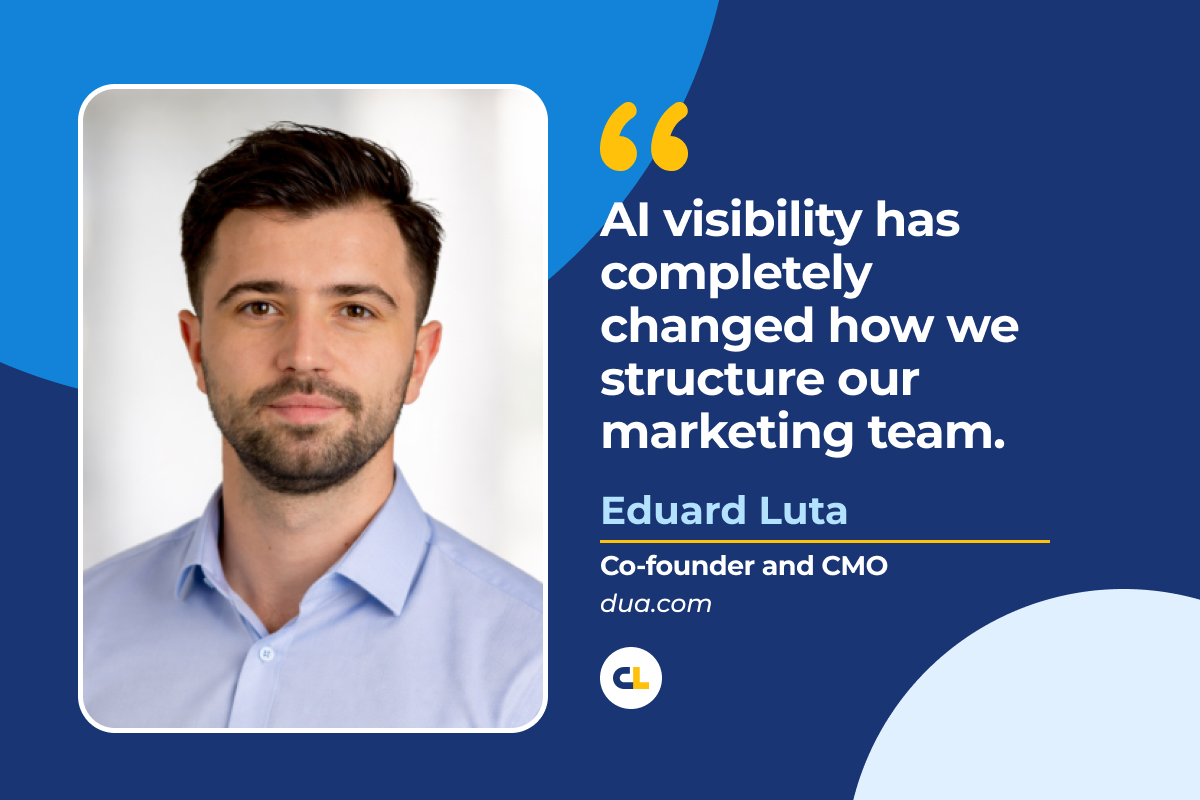
AI visibility has completely changed how we structure our marketing team. We now have two kinds of people: the ones who engineer the systems, and the ones who work on quality and ideas. Either you build the systems that run the department, or you bring the quality and the ideas that go into them. Everything else is obsolete.
Everything external gets questioned through the same two lenses. We only work with an agency if they’re ahead of us. And honestly, I don’t believe a consultant who isn’t building with AI themselves can bring real value today. At this pace, anyone who isn’t living in the future already has a fragile understanding of what’s going on.
So the rule is simple: If it builds our systems or our quality, it stays in-house. We bring in outside help only when they’re ahead of us.

Either you build the systems that run the department, or you bring the quality and the ideas that go into them. Everything else is obsolete.
– Eduard LutaWhat the CEO, CFO, and board want to know about AI
When we discuss AI visibility with leadership, the main question is simple: Do we really understand AI, and are we able to capitalize on it?
The re-organization answered a big part of that. But what gives us the confidence to keep going is the results. So the next question is always: Where do we see it in the numbers? How fast can we grow, and for how long?
The future is still foggy. Nobody really knows how big this revolution will be. So for us, the most important thing is to make AI a fundamental part of how we develop as a company, in our engineering and in our quality.
How to get leadership on board with AI-visibility investments
If you’re trying to get an AI visibility initiative approved, don’t sell AI visibility. Sell what it brings.
Leadership doesn’t care about prompts, citations, or visibility scores. They care about customers and revenue. So start with your own data. Open Google Analytics, look at the visitors who come from ChatGPT and the other assistants, and compare what they do with everyone else. For us, that’s 41% of AI visitors clicking to get the app, against 23% from search. One number like that says more than any presentation.
Then make it real. Ask ChatGPT the questions your customers ask, and show leadership the answers. If you’re not in them, your competitor is. That usually ends the discussion.
Be honest about what you can’t measure yet. Don’t promise exact attribution, because the tools aren’t there. Promise direction, and show progress every month.
And start small. Pick one area, ship fast, show the result, then ask for more. A small win in four weeks is worth more than a big plan for next year.
How we adjusted our strategy to improve lead quality
Here’s how we improved lead quality.
First, we cleaned house. We removed everything that doesn’t fit our mission and clear positioning.
You can’t be the authority for ten things. You have to follow the user’s journey through your positioning. Our mission is to connect Albanians all over the world. That’s it, and we lock in on that: from the Albanian dating app to our communities to relationships and marriage.
Second, we gave every page one clear job. Some pages are there to build trust: guides on Albanian communities across Europe and America based on official statistics, biographies, wedding traditions by region, and real love stories from couples who met on our app. They’re checked by people, with sources. Other pages are for people who are ready to meet someone, and those lead straight to the app.
Once we measured it, the difference was huge: Our dating pages bring about 30 times more app clicks per visitor than our community guides. Both matter, but you can’t ask one page to do both jobs.
Third, we showed trust instead of claiming it. Every profile on our app has to pass photo verification. We also have more than 10,000 five-star ratings. That’s what a person wants to know before they download, and I believe it’s what an AI assistant looks for before it recommends you.
Fourth, measurement. We track which page someone came from when they click to get the app. We invest heavily in measurement, reporting, and understanding what’s happening.
In short: fewer pages, better pages, and a clear path from the first question to the first match.
How we rewrote every page for depth and authority
The first challenge of rewriting our content was the scale. Rewriting every page in eight languages, and redesigning each powerpage on its own, is a huge amount of work. AI helps us move fast, but speed is also the risk. So we set one simple rule: A person checks every page before it goes live. That’s how we ensure quality.
The second challenge was getting the facts right. Our community pages are built on official statistics, and those can be tricky. In Sweden, for example, many Albanians from Kosovo are still counted under Yugoslavia. If we get something like that wrong, we lose exactly the trust we’re trying to build. So we only work with official sources and check every number before we publish. AI tends not only to make things up, but also to mix things up.
The rewrite had a tremendous effect on the quality of our traffic and on the clicks to download the app. The share of our visitors who click to get the app went from 16% to 23%. We also know that organic users create far more value for the business.
Leadership doesn’t care about prompts, citations, or visibility scores. They care about customers and revenue.
– Eduard LutaHow digital PR and unique data build authority in AI search
When it comes to AI visibility, it’s all about authority. A Wikipedia backlink is worth more today than ever. So is unique user data that nobody else has. Digital PR and UGC aren’t nice-to-haves anymore. They’re a must if you want to stay in first position.
The technical side matters much less now. What counts is real value, real expertise, and actually solving the problem.
A good example is our Top 100 Albanian Women 2026, published for International Women’s Day. We analyzed more than 300 million data points, from Google searches and social media to awards and records, and turned them into one ranking.
That’s the kind of content AI loves: unique data on a topic people actually ask about. After we published it in eight languages, its Google impressions grew from about 40 a month to almost 4,000. And one in eight of its visitors comes from ChatGPT or Perplexity, more than twice our site average.
Which signals show whether AI visibility is improving
Honestly, the most useful signals for AI visibility are the ones closest to the business, not the visibility scores.
The first is AI referral traffic in Google Analytics: visits from ChatGPT, Perplexity, Gemini, and Copilot, month by month. These visitors are still a small share of our traffic, under 5%, but they have quadrupled since July.
The second, and the one I care about most, is what those visitors do. We track how many of them click to get the app, compared to visitors from search. Visitors who come to us from AI assistants are much more ready to act. In October, 41% of them clicked through to download the app, compared to 23% of visitors from search. They already bring almost 9% of everyone who clicks to download. Traffic alone tells you very little. Intent tells you a lot.
The third is where they land. The biggest share of AI visitors arrives on our home page, not on an article. For me, that’s a strong signal: The assistant isn’t quoting us; it’s recommending us by name. It starts with a question, an article, or a prompt and ends with the brand.
The fourth is Search Console. When impressions grow, but clicks don’t keep up, AI Overviews are answering before people reach us. That gap is the best proxy we have for what happens inside Google’s AI answers.
It’s hard to attribute direct business results to AI, especially app installs and revenue. On revenue, we can’t yet follow an AI visitor all the way to a paid subscription, because the download happens in the app store and the source gets lost on the way. But when people are almost twice as likely to download, it shows they already trust the brand, and from there, only good things can happen.
For tools, we keep it practical: Google Analytics 4 and Search Console, Branch for app installs, and Ahrefs, Sistrix, and Keyword.com for links, visibility, and rankings. All of it flows into our own daily and monthly reports, so we see the numbers every morning instead of once a quarter.
What marketing leaders are getting wrong about AI search
Most marketing leaders are still hesitating. They’re not losing sleep over it, and they still work like it’s 2021. But this is a race to the stars, and it has already started.
The world has changed drastically. If leadership isn’t all in on AI, turning every stone and making every decision through the lens of AI, they’re losing, all the way. This is the biggest shift I’ve seen in my career, bigger than mobile and bigger than social. The CMOs who wait for clear answers will get them, but from their competitors.
So here’s my advice:
- Leadership needs to go all in on AI. Go through all the AI academies. Get your own hands dirty: Use AI every day, start building your own systems, and understand it from the inside, not from a presentation. Then teach the company to work through AI. Build your own reports. That’s how you get addicted.
- Look at everything through AI. Every process, every tool, every report. Ask if AI can do it better, faster, or cheaper. Most of the time, the answer is yes.
- Get into the data. Own your data, and measure what matters. Unique data is worth more than ever, for your decisions and for your visibility. And don’t stop at traffic. Look at what people actually do: click to get the app, sign up, pay.
- Rebuild your marketing around systems and quality. Let AI do the work it does better than people, and put your people on what AI can’t do: real expertise, real stories, and real trust.
- Build a team that’s all in — now — and don’t slow down. Ship, measure, learn, and ship again. You have to ship faster!
Follow along
You can follow Eduard Luta’s work on LinkedIn, X, and his website. And check out dua.com and MIK Group.
More expert interviews to come on Citation Labs!