
I started in search in 2001. We started Citation Labs in 2011 as a link-building agency.
A few months ago, we were renewing a client contract, and they asked us to remove the word “links” from the statement of work.
That was scary.
I’m a link builder. I have been for a long time. But I can’t defend the value of that work on traffic alone anymore.
Traffic started falling for most businesses in 2024. And when clients spend six figures a month on link building, declining traffic puts that line item under heavy scrutiny.
As search drives less traffic, businesses need a stronger reason to keep investing.
That has forced us to ask a different question: what can search influence beyond traffic and rankings that we can tie to business impact?
SEARCH CAN FIND AND FIX THE INFORMATION GAPS AI EXPOSES
Search can influence what AI says about you. But first, you need to know where visibility breaks down.
We use a six-layer framework to diagnose that:
- Ranked: Are our pages ranked in the query fan-outs?
- Retrieved: Does the model retrieve our pages?
- Cited: Does the answer cite our evidence?
- Mentioned: Does the answer name our brand?
- Recommended: Does the answer recommend us?
- Framing: Does the answer describe us accurately and on the right terms?
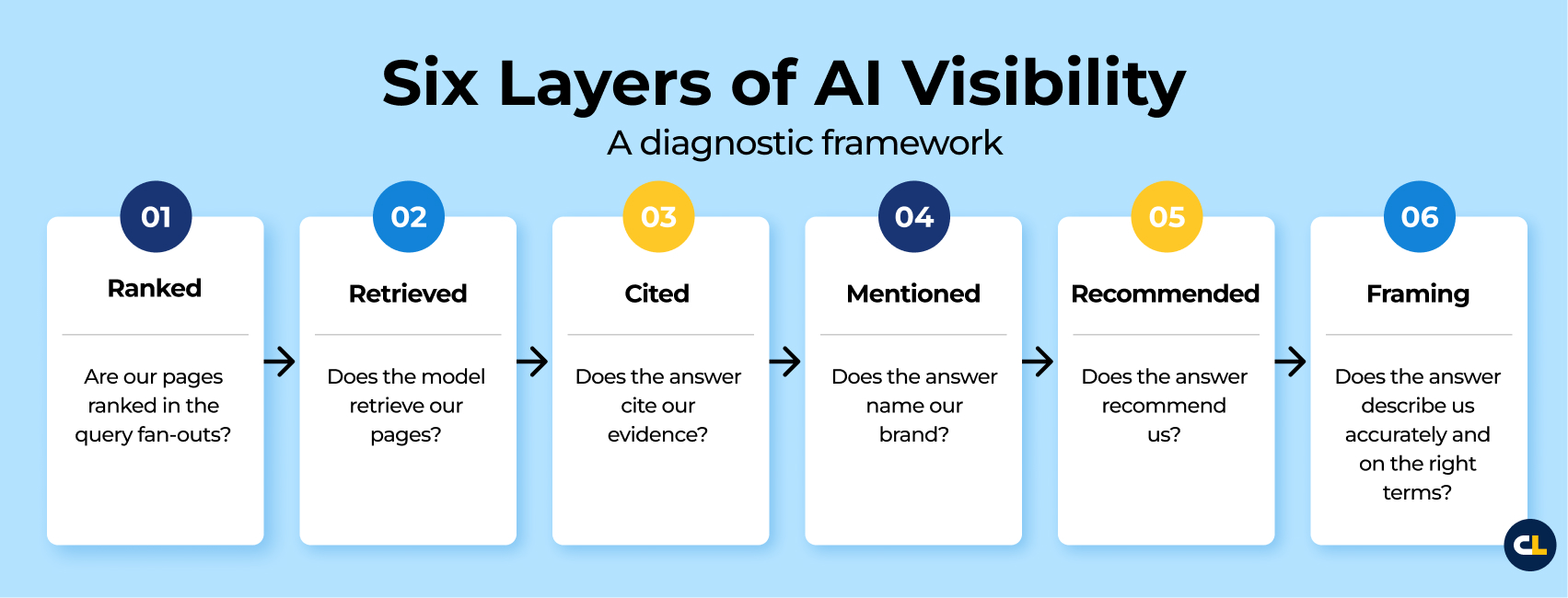
This is a diagnostic (not a causal funnel).
If your pages don’t rank in the QFOs, they’re unlikely to get retrieved. If AI doesn’t retrieve your pages, it’s unlikely to cite your evidence. And if the answer doesn’t cite your evidence or mention your brand, it’s less likely to recommend you.
The six layers show us where to investigate. Then we analyze query fan-outs to understand what information AI looks for when answering buyer-decision prompts.
We start with buyer prompts that don’t name a brand. They’re role-specific, and each includes a decision that could lead to a vendor choice.
For example, an industrial computing buyer may need to know whether a system will work with existing PLCs, fit the cabinet, survive heat and vibration, stay supported for five years, and how quickly it can be replaced or repaired if it fails at 2 a.m.
The query fan-out shows how AI breaks those needs into retrievable questions.
From there, we can then see which questions have answers, where information is missing, and which sources AI retrieves and cites.
Then, we intervene.
We might change information on the client’s site, work with a third-party publisher AI already cites, or publish the missing information off-site.
Once those changes are in place, we track recommendation rate over time to see whether the intervention improved AI visibility.
AI VISIBILITY HAS TO CONNECT TO BUSINESS OUTCOMES
That still leaves the bigger questions:
- Did anything else change?
- Did it affect conversions?
- Did it improve an outcome another team cares about?
For years, search teams didn’t have to ask those questions as often because we drove traffic. We drove so much traffic.
Those were the good old days.
As search drives less traffic, visibility alone won’t justify the investment.
So we need to connect search work to key business outcomes. That means working more closely with sales, PR, legal, and operations.
Those teams have information problems search may be able to help solve, and they often control the information or surfaces we need to change. Legal may own the claim. PR may own the publisher relationship. Brand may decide whether we can participate on Reddit or the open web.
But don’t walk into those meetings with a dashboard assuming you know what matters. Learn the team’s problem first. Find an outcome they already measure, then see whether better information can change it.
START WITH SALES TO FIND BUYER INFORMATION GAPS
Sales is the best place to start because it hears what buyers ask when they’re deciding.
Those conversations show where buyers get stuck, what they still need to understand, and what they need to verify before moving forward.
Ask sales:
- What objections keep coming up before buyers put us on the shortlist?
- Where do buyers struggle to determine whether we fit their situation?
- What claims do buyers need proof for before they’ll move forward?
- Where does the buying group get stuck trying to agree on the next step?
Those questions expose information gaps.
A repeated objection may mean the answer is missing or hard to find. A buyer struggling to establish fit may need clearer comparison criteria. A stalled buying group may need stronger proof or information it can use to reach agreement internally.
That gives search teams something concrete to work on: improve the information buyers need, make it easier to find and retrieve, and then measure whether it changes the sales outcome.
DESIGN FOR INFORMATION NEED, NOT KEYWORD DEMAND
Sales is only the starting point.
The same pattern shows up across the business: what do people keep asking that someone has to explain over and over again?
That repeated question points to an information design problem.
For example:
- Sales keeps explaining who the product is and isn’t a fit for.
- Operations keeps answering questions customers should have been able to resolve themselves.
- PR keeps trying to get important messages repeated accurately and with evidence behind them.
- Legal has to deal with claims about the company that AI surfaces.
You’re not looking for keyword demand. You’re looking for what someone needs to understand, verify, or do to solve a problem or make a better decision.
Search teams can help create that information, make it easier to find and retrieve, and then measure whether it changed the outcome.
The outcome depends on the problem:
- For sales, that might mean shortlist presence, buyer-fit clarity, or opportunity progression.
- For operations, it might mean self-serve deflection or whether work starts with the right information already in hand.
- For PR, it might mean whether important messages appear accurately and with supporting evidence.
- For legal, it might mean whether the sources AI uses to describe the company have been reviewed.
Will that work always drive traffic?
Probably not.
But that’s the point. If we understand what people need to know, improve that information, make it retrievable, and track whether it changes an outcome, search can contribute far beyond the next click.
To apply the same AI visibility, information design, and business-impact methodology Garrett walked through in the presentation, start with the Citation Labs Operating System.