SEO teams are under more pressure to explain their value.
Clicks, traffic, and rankings continue to look worse. Paid and programmatic channels can look cleaner because the reporting feels more direct, but they don’t solve AI answer visibility. For now, most AI answer surfaces offer limited ways to buy placement directly.
That makes the job harder for SEO teams: showing where search still influences revenue when the numbers no longer capture the full path from research to decision.
No wonder leadership keeps asking whether SEO is still worth the budget.
This pressure isn’t new.
SEO gets declared dead every few years because major technology shifts make people question whether buyers will search the same way and whether SEO will still influence decisions.
AI search creates the latest pressure. The data shows buyers still search, but Google now shapes more of the decision before the click.
In AI Mode, a buyer can ask a question, get a shortlist, compare options, and move toward a decision before opening a website.
That makes AI answer visibility part of SEO measurement.
What the AI Mode Behavioral Study Showed
Our behavioral study gave participants high-consideration purchase tasks and observed how they worked through decisions in AI Mode and standard Google Search.
Participants narrated their thinking as they searched, which allowed us to see where they accepted recommendations, where they visited external sites, and how much research occurred before a site visit.
When users received a concise set of recommendations, they often accepted it without further exploration.
88% of users accepted the AI shortlist
AI Mode can create the decision set. When Google presents a concise shortlist, users often consider only those choices.

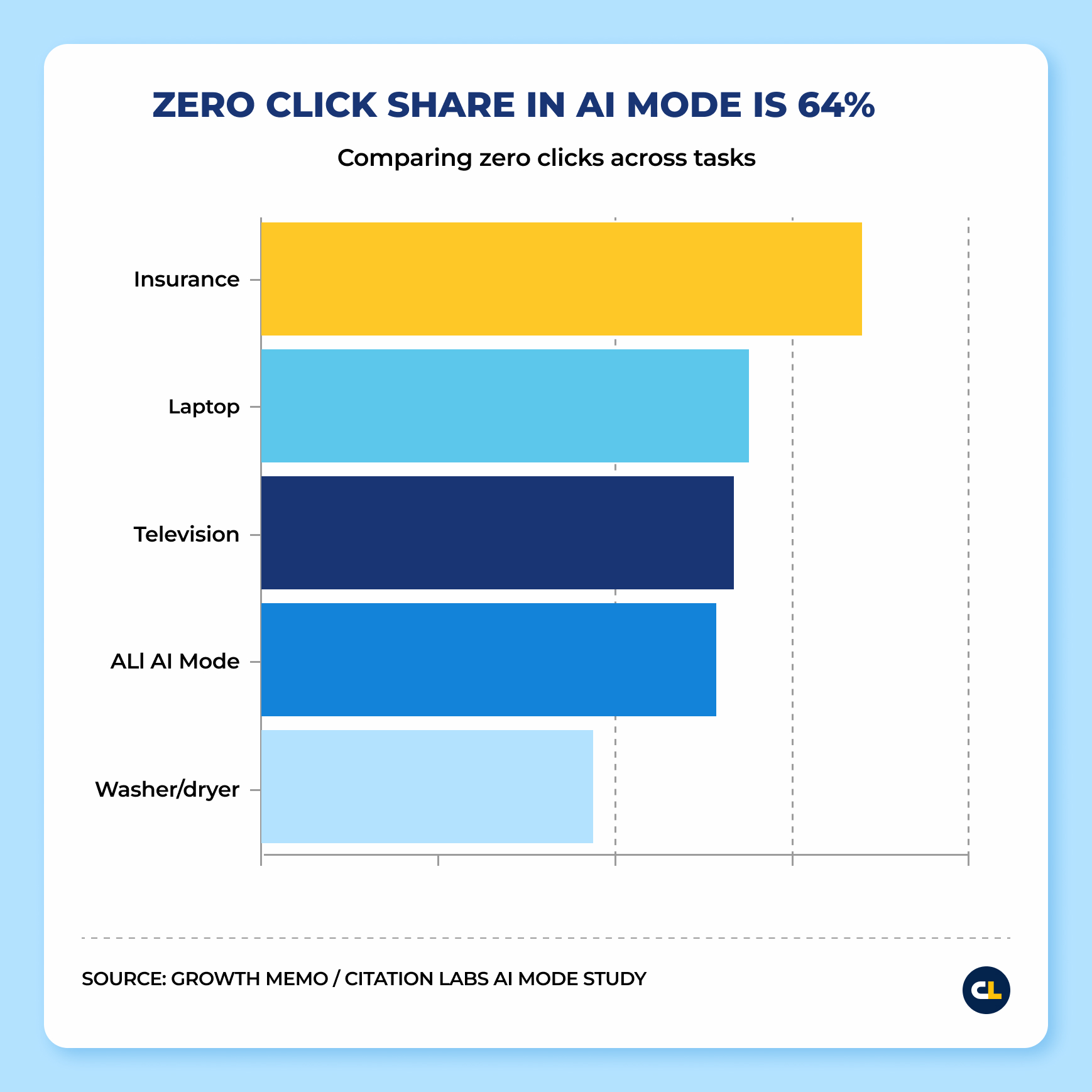
Zero-click share in AI Mode was 64%
AI Mode kept more of the comparison process inside Google.
In high-consideration purchase tasks, users often started with the AI answer and visited external sites only when they needed more validation.
The click may now represent late-stage validation or purchase intent (not the full research journey).
74% of participants chose the first item as their top pick
Rank still matters, but AI Mode changes how users experience it.
AI Mode often returns a shorter list of recommendations, and users were much more likely to choose the first result.
For context, pre-ChatGPT CTR studies often placed Google’s first organic result around 28.5% on average, with position-one CTR rising to roughly 34% on purely organic SERPs.

Not in the shortlist? Your brand doesn’t exist.
Clicks still happen from Google, but often after AI has guided buyer research.
By that point, the user has seen a smaller group of options and enough context to decide what deserves more attention.

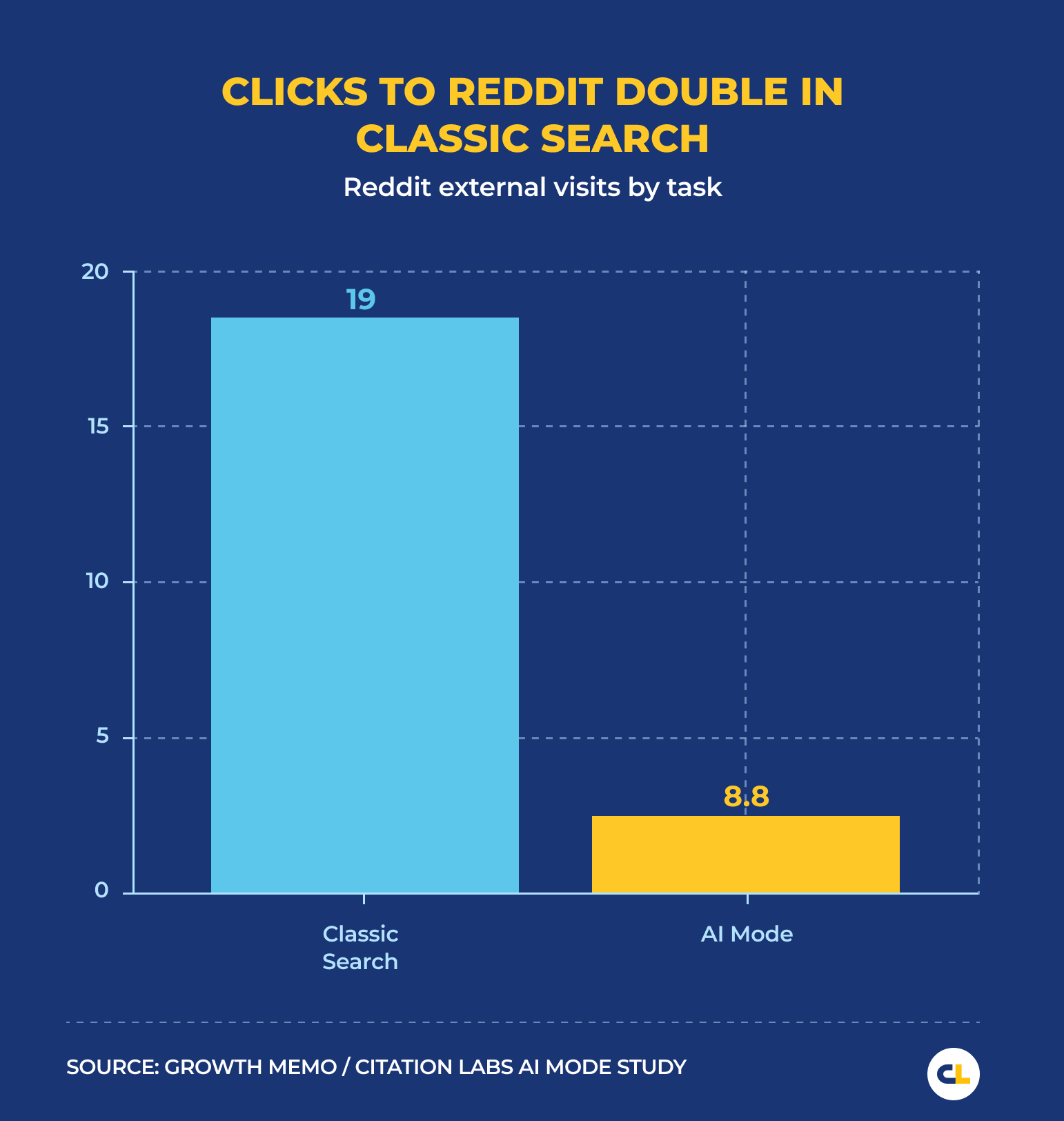
In the study, only 23% of AI Mode tasks involved an external site visit, compared with 67% in standard search.
In high-consideration categories, users often did more of the research inside the answer experience.
AI Mode hides more of the research trail.
By the time a buyer clicks, Google has already narrowed the options, explained the rationale, and ranked the recommendations.
For SEOs, traffic no longer shows every place search shapes consideration.
Teams need to measure the answer experience before the visit.
The Click Now Captures Less of the Search Journey
Traditional search results still matter because they can help shape the AI answer, but the visible search experience has changed.
A buyer can still click, compare, validate, and buy on a site.
But the click may happen after Google has already framed the problem, reduced the options, cited the supporting sources, and given the user a ranked list to consider.
Behind that experience, Google’s AI Mode can classify intent, query Google’s own search systems, knowledge graph, and other internal data, then use a limited set of retrieved sources to shape the answer. The user sees the answer, the citations, and the ranked recommendations, not the internal retrieval path that produced them.
Other AI systems can expose a clearer version of a similar process. When a prompt triggers search, they may run query fanouts, build a retrieval set, and use a limited number of sources to ground the answer. That makes the mechanics easier to observe outside Google, even if Google’s process works through its own systems.
Recent advances in model efficiency and vector search (like TurboQuant) may also make answer generation more capable over time.
Meanwhile, the ten blue links still influence the answer experience, but they no longer define what the user sees first. The system can use search results, citations, entities, and third-party sources to decide what to include.
Users may see three to five recommendations, a few cited sources, and a summarized rationale before they ever visit a site.
That means SEOs need to measure the AI answer experience directly.
Rankings and traffic still show part of the picture. They can tell you where you rank and whether someone reached your site. But they won’t tell you whether Google mentioned your brand, cited your content, used your content without naming your brand, ranked a competitor above you, or left you out of the recommendation list.
That creates the measurement problem: SEO reporting has to account for visibility before the buyer reaches the site.
Traditional search already gives SEOs a partial version of this through impressions. Search Console can show where a page appeared even when the user didn’t click. AI answer visibility creates a similar gap, but earlier and less cleanly: the brand may appear, get cited, shape a shortlist, or lose to a competitor before analytics records a visit.
Clicks Alone Can’t Defend SEO Budget
Leadership still expects SEO to show impact, but the reporting has become harder to explain.
Rankings, traffic, and conversions remain useful, but they miss part of the influence search creates when AI answers help buyers narrow the field before they click.
SEO teams need to give leadership a cleaner way to see lost visibility before traffic drops, because the channel still gets judged by visits, conversions, and pipeline.
That makes SEO look weaker than it is.
Measure AI Answer Visibility Alongside Traffic
SEO teams need to measure where search influences selection before the visit.
Start with the questions buyers ask as they move from general research into comparison, validation, and decision-making.
Prioritize questions that:
- Come up during early category research
- Compare providers, products, or approaches
- Test claims, proof, pricing, risk, implementation, or fit
- Sit close enough to purchase to influence the shortlist
- Deserve ongoing measurement because they shape buyer consideration
AI visibility measurement starts there: before the click and before the buyer has narrowed their options.
Then look at where those questions get answered. The same buyer may use standard Google Search, see an AI Overview, continue into AI Mode, and ask another AI tool, so buyer questions and AI answer experiences both matter.
Next, check how Google presents those searches. Do they show a traditional results page, an AI Overview, or an AI Overview with a clear path into AI Mode? AI Mode should also be reviewed directly, as buyers can switch to that experience even when the standard results page still shows traditional links.
That shows where the brand can win or lose consideration before a site visit appears in analytics.
From there, separate the signals that clicks and rankings won’t show:
- Does the brand appear in the answer?
- Does Google cite the brand’s page as a source?
- Does the answer name the brand clearly, or does Google use the page while leaving the brand buried?
- When Google returns recommendations, where does the brand rank?
Then look past the answer.
Earlier answer exposure may show up later in branded search, assisted conversions, direct traffic, sales feedback, customer conversations, form data, CRM source fields, and sales notes.
None of those signals will prove the full path on their own, but together they help show whether search influenced selection before the click.
AI answer data still has gaps, so the first step isn’t perfect attribution. Treat this as a visibility snapshot: a structured view of whether the brand appears, gets cited, ranks, or disappears across priority buyer questions.
You don’t need fully automated reporting to start.
Run priority buyer questions multiple times, then check the standard results page, AI Overviews, and AI Mode directly.
Compare what each experience shows: brand presence, citations, competitor mentions, recommendation order, and missing visibility.
This doesn’t replace the need to measure traffic, rankings, or conversions. It gives SEO teams a way to show where search shaped consideration before those signals appeared.
Measure and Improve AI Visibility with Citation Labs
Manual review can show the problem.
Ongoing tracking shows whether visibility changes across priority questions, answer types, competitors, and citations.
Our team at Citation Labs uses Xofu to test the buyer questions people use when they research a category, compare providers, validate claims, and move toward a decision.
The snapshot shows where a brand appears across AI Overviews, AI Mode, and other AI answer experiences, which competitors appear instead, and which buyer questions need ongoing tracking.
That view guides citation optimization:
- Create content AI systems can reference confidently
- Strengthen third-party proof beyond the brand’s own site
- Earn links and placements from sources that help shape AI answers
- Close gaps in content, citations, entity clarity, and third-party validation
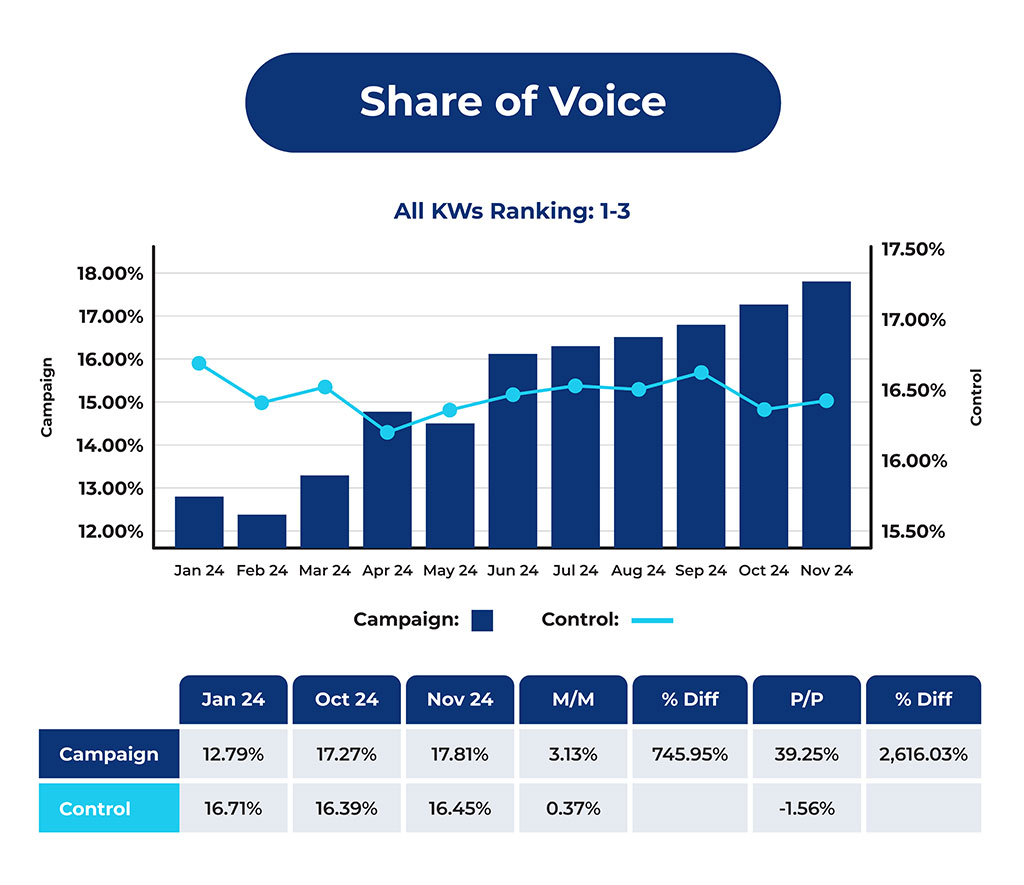
We also track campaigns against controls (baseline prompts and pages), so in-house teams can show leadership where visibility changed.
You don’t need a perfect attribution model.
Start with the buyer questions closest to purchase decisions. Run them across the AI answer experiences buyers now use.
Track whether the brand appears, whether Google cites it, where competitors win the recommendation, and whether branded search, direct traffic, assisted conversions, sales feedback, or first-party source data starts to change.
Search still influences selection.
SEO teams need to move measurement earlier in the journey.