
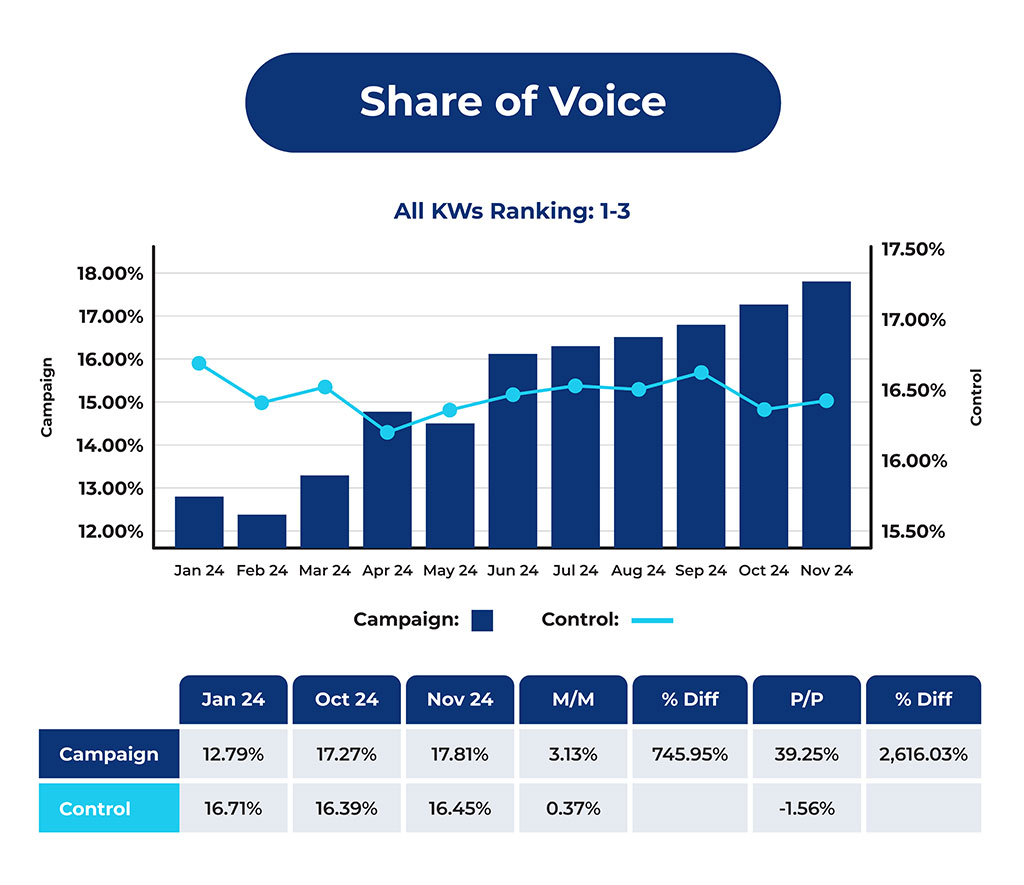
A national wireless provider wanted to test whether local sponsorship links could improve the visibility of its location pages and the Google Business Profiles tied to them.
We decided to run an experiment.
The location pages had very few or no links. They competed in saturated markets, and many competitors were larger, better-established brands.
Our hypothesis: Local sponsorship links could introduce a hyperlocal signal those competitors didn’t appear to be using and help the locations stand out.
There was some precedent for the test.
We’d used a similar tactic with other brands and identified improvements for both local landing pages in traditional search and Google Business Profile visibility. But those were different businesses, markets, and competitive environments.
For this experiment, success meant measurable lift in either place: stronger Google Business Profile visibility within the measured grid or better visibility for the individual location pages in local search.
So we set up the test to see whether the sponsorship links could move either signal enough for us to measure it.
Testing Local Sponsorship Links Across Multiple Markets
We started with a couple dozen locations provided by the client.
We didn’t have the full national footprint to choose from, so we worked within that set and selected roughly four or five test locations, along with other locations to use as controls.
From there, our team identified relevant community organizations in each test market. They handled outreach, worked through the organizations’ vetting and approval process, secured the sponsorships, and launched the placements.
The experiment ran for roughly six months, including the time required to secure the sponsorships, with the live placements monitored for several months.
The test was deliberately limited to local sponsorship links.
With multiple markets and other variables already in play, adding different tactics would have introduced even more variability. Keeping the tactic consistent meant testing as few things as possible at the same time.
BrightLocal was used to measure the two outcomes central to the hypothesis:
- Improved visibility for the individual location pages in traditional search.
- Improved visibility for the Google Business Profiles in map results.
No Clear Sponsorship Signal: Mixed Test and Control Results
After roughly six months, we couldn’t demonstrate lift that we could confidently attribute to the sponsorships.
The results moved in different directions across both the test and control locations. Some markets improved, some stayed roughly flat, and one declined slightly. Another control market improved as well.
In traditional search, the state pages also continued to outperform the location pages.
The locations receiving sponsorships didn’t improve more consistently than the control locations. Both groups saw similar swings, including visibility gains in locations that received no sponsorships. No clear winner emerged, and no clear correlation appeared between the sponsorship work and movement from one market to another.
That was especially important in the markets that did improve.
One of the larger markets received a relatively small number of sponsorships and still saw lift. At the same time, some smaller markets received proportionally more of the work and didn’t see the same improvement.
I’d have expected the smaller market with an outsized percentage of the work to grow more substantially than the larger market with less of it. That pattern just wasn’t there, so I couldn’t confidently say the sponsorships caused the lift.
The test also left a bigger issue unresolved:
The markets weren’t similar enough in shape or size to create a clean A/B comparison. In one case, we were comparing a very large metropolitan market, probably a top-10 DMA, with a market that wasn’t even part of a DMA.
We tried to select the cleanest test and control groups from the locations available, but there simply wasn’t enough similarity between them.
It wasn’t an apples-to-apples test, which made the overall result inconclusive.
Test Scale and Competitor Footprint Obscured the Sponsorship Signal
The test’s scale was one challenge.
The budget was $25,000, but this wasn’t a single-location or regional business. It was a national organization competing against large brands that showed up consistently across the markets in the test.
To move the needle, the test needed a much larger lever to pull.
The footprint size makes that easier to see. In one area alone, the brand’s site had more than 70 locations. The test covered one location in each market. At that scale, the budget couldn’t simply be spread across the national footprint and still create enough concentration to tell us much.
The competitive structure added another layer of complexity.
The client had its own standalone retail locations, but the same service was also available through much larger retail partners. In a given market, visibility was split between its own physical locations and its presence inside those larger retailers.
It was a kind of co-opetition. The standalone locations weren’t only trying to stand out against direct competitors. They were also competing for visibility alongside a much larger retail footprint around the same offering.
Reviews were another market signal, but this test didn’t control for them.
The question was whether local sponsorship links (something the competitors didn’t appear to be using) could create enough of a signal to overcome some of those other factors. At the scale tested, we couldn’t isolate that signal with enough confidence.
Key Learnings for Future GBP and Location Page Tests
If I could run the test again, I’d change several things, starting with more budget, more freedom to choose the markets, and more flexibility in the pages we targeted.
The first is scale.
A $25,000 pilot can tell you something, but for a national organization with this many locations and this level of competition, a high-confidence test would require substantially more investment.
For a high-confidence test at this scale, I’d be thinking closer to a $1 million to $2 million budget. That sounds like a huge test budget until you look at the business behind it. This was a national brand with dozens of locations in individual markets and a much larger overall marketing budget.
If a smaller pilot had demonstrated that sponsorship links could reliably improve visibility, funding a larger test could have been relatively small compared with what the company was already spending through channels like paid search.
The second change is market selection.
The original test was limited to roughly 22 priority locations across the country, which pigeonholed the experiment from the start. Because they were priority markets, they were also likely to be places where visibility was already weaker, or competition was higher.
I’d want the freedom to select markets based on the quality of the experiment instead. The fewer guardrails around market selection, the better our chance of creating an apples-to-apples comparison.
I also wouldn’t limit the test to one page type.
Other pages on the domain were already ranking in traditional search, while the location pages weren’t ranking anywhere to start. So this wasn’t just about boosting those pages. We were trying to supplant pages Google favored with pages not ranking at all.
That added another layer of difficulty before the sponsorships even entered the equation. The biggest structural change would be how we tested the locations.
I wouldn’t repeat the approach of testing one location in each of several different markets. I’d flip it: pick one market, test several locations within it, and compare those results against locations where we didn’t build sponsorships.
Keeping more of the test inside the same geography would make the competitive environment more stable and give us a better chance to account for variables such as the population around each location.
If we wanted to compare separate markets, they’d need to be similar enough in location count, competition, and other conditions to create a closer apples-to-apples test.
Then the work could go deeper across multiple locations instead of being spread across unrelated single locations. The outcome would also be more actionable for both the market strategy and the individual locations.
Measurement would also become part of the test design from the beginning.
We had limited ways to slice the reporting data in the format we needed. Next time, I’d define the measurement requirements upfront and make sure the reporting setup, including custom reporting or tooling if needed, can track the experiment in the ways required from day one.
Next time, the goal is a cleaner test that gives us a better chance of isolating whether the sponsorships are actually moving visibility.